AI Growth Is Strong. Who Is Turning It Into Cash?
Microsoft, Amazon, Alphabet and Meta show different paths from AI demand to shareholder returns. We compare cloud growth, earnings quality, capital spending and cash generation in their July–September 2026 results.
Reading Big Tech earnings simply as a contest between companies that beat expectations and those that miss them obscures an important shift. Cloud revenue can accelerate while cash after investment falls. Net income can decline even as operating profit grows.
Across Microsoft, Amazon, Alphabet and Meta, AI demand is already supporting revenue. The investor question is increasingly how much of that demand becomes profit and cash. Microsoft offers broad enterprise monetization; Amazon concentrates much of its profit in AWS; Alphabet combines rapid cloud expansion with a growing funding burden; Meta must balance AI-driven advertising improvements against upfront investment.
Four companies, four earnings profiles
The comparison covers July–September 2026: Microsoft’s fiscal 2027 first quarter and the other companies’ third quarter of 2026. Revenue growth and operating profit reveal different aspects of their businesses.
| Company | Revenue; year-over-year growth | Operating income; margin |
|---|---|---|
| Microsoft | $92.3bn; +19% | $45.9bn; 49.8% |
| Amazon | $201.9bn; +12% | $28.1bn; 13.9% |
| Alphabet | $127.6bn; +25% | $40.6bn; 31.8% |
| Meta | $64.6bn; +26% | $13.0bn; 20.1% |
Sources: Microsoft, Amazon, Alphabet, PDF, and Meta. Amounts in US dollars. Meta’s operating income includes a litigation-related charge.
Scale and profitability are different things. Amazon’s retail operations incur purchasing and delivery costs that differ from those of Microsoft’s software business. Overall margins are more useful when understood alongside what earns the money and where the company spends it.
A miss also needs a specific definition. Revenue below forecasts, weaker operating earnings, investment losses that depress earnings per share (EPS), and disappointing guidance are different events. Share prices reflect prior expectations and investment commitments as well as reported results. The business performance and the market reaction should be assessed separately.
Cloud growth has more than one source
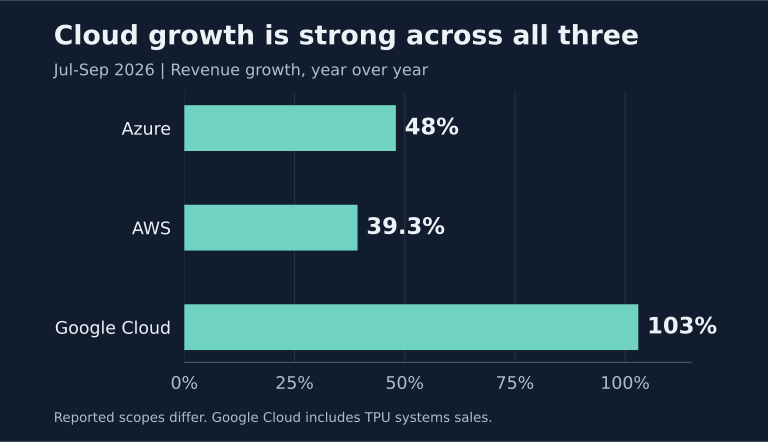
Figure 1: Cloud revenue growth, year over year, July–September 2026. Sources: company earnings releases. Google Cloud’s expansion also benefited from TPU systems sales alongside cloud services.
All three providers sell computing resources and operating infrastructure to businesses adopting AI. How they reach customers and convert growth into profit differs.
Microsoft: enterprise applications and infrastructure together
Microsoft reported 48% Azure revenue growth and 17% reported growth in Microsoft 365 commercial cloud revenue. Its revenue opportunities span computing infrastructure and the software customers use every day.
The attraction for investors is that Microsoft has relatively less need to build a customer base from scratch. Adding capabilities around existing workflows, data, identity and cloud operations can combine greater computing consumption with recurring software subscriptions. Existing businesses also contribute to growth; the entire revenue increase cannot be attributed to AI.
With an overall operating margin near 50% and operating cash flow exceeding the equipment spending discussed below, Microsoft’s quarter provides relatively clear evidence of growth alongside cash generation. Sustaining those margins as investment rises remains a central test.
Amazon: retail scale, AWS profits
AWS generated $46.0 billion in revenue and $17.8 billion in operating income. That was approximately 23% of Amazon’s total revenue but 63% of its operating profit. Treating Amazon solely as a retailer misses its earnings structure.
AWS grew 39.3%, while Amazon’s overall operating margin reached a record 13.9%. Retail revenue also requires a calendar adjustment: according to Amazon, Prime Day moved from the third quarter last year to the second quarter in most major countries this year. Without that shift, consolidated revenue growth would have been approximately four percentage points higher. The reported retail growth rate should not automatically be read as weakening demand.
The next question is whether investment to serve AWS demand delivers an adequate payoff. Amazon expects approximately $220 billion in cash capital expenditures during 2026 and forecasts fourth-quarter operating income of $28.5 billion–$33.5 billion. Its growth opportunities come with a substantial current funding commitment.
Alphabet: cloud expansion and the EPS distinction
Google Cloud revenue reached $30.7 billion, up 103%. Search and other revenue rose 12%, and consolidated operating income increased 30%. Those operating results do not describe a broad business slowdown.
Nevertheless, EPS fell from $2.87 to $2.12. Alphabet reported that approximately $8.7 billion in equity investment losses reduced net income by about $6.7 billion and EPS by $0.55. Operating earnings should be distinguished from bottom-line results affected by investment valuations and other items. Removing that EPS effect alone would still leave earnings below the prior-year level, so it cannot explain the entire decline.
Alphabet has cloud infrastructure, its own AI-oriented TPU chips, AI models and customer access through Search. It can sell infrastructure externally while using AI to strengthen its own search business. Investors must assess how much cloud expansion translates into recurring revenue, whether search monetization remains resilient, and whether infrastructure spending earns its return.
Meta: improve advertising before selling AI
Meta’s revenue rose 26%, with ad impressions up 10% and average ad prices up 14%. Management said improvements in AI recommendations and monetization were generating incremental revenue. Unlike the three cloud providers, Meta’s main route to monetizing AI is to make existing advertising more effective.
A $9.89 billion litigation-related charge heavily affected the 37% decline in operating profit. Meta said operating income excluding that charge would have been $22.88 billion, compared with reported operating income of $12.99 billion. Conversely, the sharp increase in net income also reflects a much heavier tax burden in the prior-year quarter. Neither revenue growth nor the bottom-line growth rate alone captures underlying advertising performance.
Meta forecasts fourth-quarter revenue of $73 billion–$76 billion and full-year capital expenditures of $135 billion–$145 billion. The issue is whether advertising gains keep pace with investment in areas such as frontier models, where returns take longer to materialize.
How much cash survives the investment cycle?
The contrast becomes clearer when moving from accounting profit to cash. Operating cash flow measures cash generated by operating activities. Spending on data centers and servers is not charged entirely against earnings immediately: equipment costs are allocated across later periods through depreciation. Cash can therefore leave before the full expense appears in earnings.
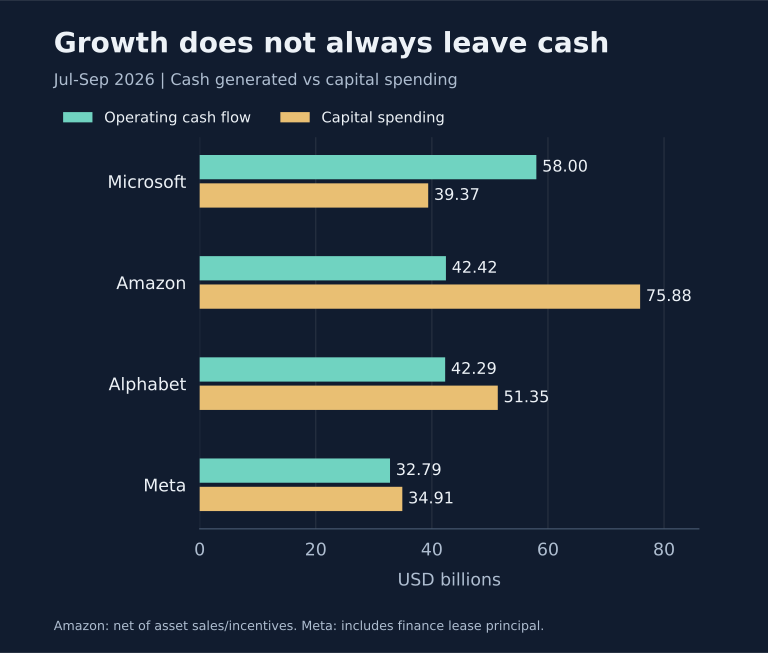
Figure 2: Cash generated by operations in green and equipment-related cash spending in gold, July–September 2026, in US$ billions. Microsoft funded equipment spending within its operating cash generation; investment ran ahead of that cash generation at the other three companies.
| Company | Cash after equipment-related spending |
|---|---|
| Microsoft | +$18.63bn |
| Amazon | −$33.46bn |
| Alphabet | −$9.07bn |
| Meta | −$2.12bn |
Sources: Microsoft, Amazon, Alphabet, PDF, and Meta. Figures subtract equipment-related cash spending from operating cash flow. Spending definitions differ: Microsoft uses cash equipment purchases, Amazon nets asset-sale proceeds and incentives, and Meta includes finance-lease principal payments.
A negative number does not automatically indicate a troubled business. Companies are adding capacity ahead of future demand. But the investment earns its value only when future revenue and profits follow. AI growth alone does not make its funding cost irrelevant.
Microsoft’s operating cash covered its equipment outlay this quarter. Amazon’s spending ran substantially ahead of cash generation, while Alphabet also spent more on equipment than it generated from operations. Those differences inform how much companies may need to rely on existing cash or financing. Quarterly spending timing matters, so the pattern should also be followed across subsequent quarters and the full year.
What to track before the next earnings release
Each investment thesis can be translated into observable indicators.
| Company | Evidence of strength | A weaker outlook would involve |
|---|---|---|
| Microsoft | Azure and business-software growth, operating margins, cash after equipment spending | Rising investment without matching growth, profit or cash |
| Amazon | AWS revenue and profit, investment payback, retail performance adjusted for timing | Slower AWS growth alongside persistent funding pressure |
| Alphabet | Search revenue, the composition of Cloud revenue, cash after investment | Weaker search economics or delayed returns on expanded infrastructure |
| Meta | Ad impressions and pricing, earnings separated from unusual charges, investment levels | Cost and equipment burdens growing faster than advertising improvements |
Our base outlook is that AI demand supports growth while differences in the time needed to deliver shareholder returns widen. Microsoft has broad enterprise revenue and cash generation; Amazon has AWS growth; Alphabet has Search and Cloud; Meta has improving advertising performance.
A good business, however, is not automatically a good investment at any price. When strong growth is already reflected in valuations, further upside requires results beyond those expectations. This operating comparison does not rank the stocks by current cheapness or fair value.
Investors should focus on how quickly added demand becomes profit and cash, rather than on the size of the AI spending announcement. Following cloud or advertising growth alongside the funding required to produce it offers a more useful way to assess growth quality than reacting to a single EPS beat or miss.